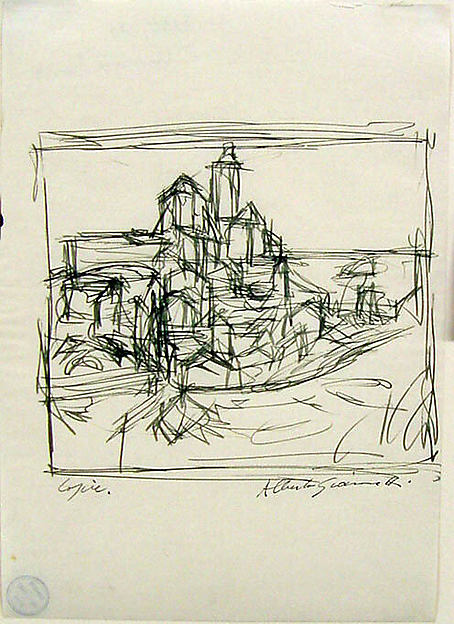
Hill Town
1943
About this work
Hill Town by Alberto Giacometti, from 1943, is a pen and ink drawing on paper in The Metropolitan Museum of Art. This work measures 11 9/16 × 8 1/8 inches. The collection recorded the object around 1948. The drawing depicts towns. A viewer can see the artist's rendering of architectural forms and landscapes on a modest scale. The medium of pen and ink suggests a direct and linear approach to the subject matter. The date of record indicates its entry into the collection several years after its creation. Its acquisition by the museum is recorded.
More work




Notable works
- Annette (1961). Annette, by Alberto Giacometti, from 1961, is an oil on canvas in The Metropolitan Museum of Art. 5 cm). The collection recorded this work in 1961. The painting depicts portraits of women. The size and medium suggest a significant painted work, focusing on a specific subject. The consistent recording date with the year of creation suggests it was acquired or documented shortly after its completion.
- Small Bust on a Plinth (Diego) (1947). Small Bust on a Plinth (Diego), by Alberto Giacometti, from 1947, is a painted plaster in The Metropolitan Museum of Art. 1 kg). The collection recorded this object in 1947. The sculpture presents a bust of a man, indicating a portrait. The use of painted plaster, a less durable material than bronze, suggests a different artistic intent or stage in the creative process. The inclusion of a plinth as part of the work emphasizes its sculptural nature and presentation.
- Standing Woman (1946). Standing Woman, by Alberto Giacometti, from 1946, is a painted plaster in The Metropolitan Museum of Art. 4 kg). The collection recorded this object in 1946. The sculpture depicts a standing woman. The slender form and light weight of the plaster suggest a delicate or attenuated representation. The choice of plaster as a medium allows for a directness in the artist's modeling. The work's small dimensions contribute to an intimate scale.
- Still Life with an Apple (1937). Still Life with an Apple, by Alberto Giacometti, from 1937, is an oil on canvas in The Metropolitan Museum of Art. The painting measures 28 3/8 × 29 1/2 inches (72.1 × 74.9 cm). The collection recorded this work in 1937. The composition features apples and other elements typical of a still life, arranged on what appears to be furniture. The work's dimensions suggest a canvas of modest size, allowing for a focused study of its subjects. The collection has a credit recorded for this work.
- Studies of Diego (1962). Studies of Diego, by Alberto Giacometti, from 1962, is a work in red ballpoint pen and pen and black ink on paper in The Metropolitan Museum of Art. The drawing measures 8 1/4 x 6 1/8 inches (21 x 15.5 cm). The collection recorded this work in 1962. The subject of the drawing is men. Its small scale suggests an intimate or preparatory study, focusing on the human form. The use of two different ink types indicates a deliberate approach to line and tone. The collection has a credit recorded for this work.
- Tall Figure (1947). Tall Figure, by Alberto Giacometti, from 1947, is a bronze sculpture in The Metropolitan Museum of Art. The work stands 79 1/2 × 8 5/8 × 16 1/4 inches (201.9 × 21.9 × 41.3 cm) and weighs 99 pounds (44.9 kg). The collection recorded this work in 1947. The sculpture's substantial height and narrow form are notable, presenting a distinct silhouette. Its material and dimensions indicate a significant three-dimensional object. The collection has a credit recorded for this work.
- Woman of Venice II (1956). Woman of Venice II, by Alberto Giacometti, from 1956, is a painted bronze in The Metropolitan Museum of Art. The sculpture measures 47 7/8 inches by 13 1/4 inches by 6 inches and weighs 30.7 pounds. The collection recorded this work in 1956. This artwork depicts a woman, rendered in a distinctive, attenuated form. The scale of the work, nearly four feet tall, gives it a significant physical presence. The choice of painted bronze as a medium allows for both the sculptural form and a surface quality that contributes to the overall impression of the figure. The acquisition of the work is recorded by the collection.