4 February 1881 – 17 August 1955 · Argentan
Fernand Léger
Work
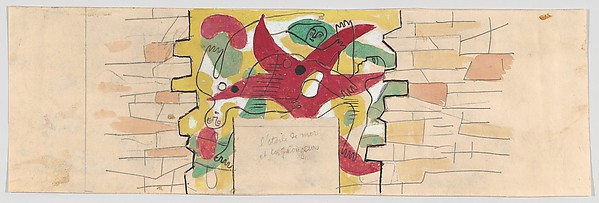
Fernand Léger's work includes paintings, sculptures, and designs. His subjects ranged from landscapes like "Rooftops" (1915) and "The Village" (1914) to figure paintings such as "Accordion Player" (1922) and "The Smoker" (1951). He also depicted groups of people in works like "The Builders" (1914), "The Bicyclists" (1951), and "Divers, Blue and Black" (1942). Léger explored still life with pieces like "Nature Morte (Still Life)" (1943) and "Still Life" (1929). His designs include "Six Designs for Abstract Wall Decorations" (1935) and "'Starfish and Swimmers': Design for a Mosaic or Mural" (1937). Other notable works include "Composition in Blue" (1921), "Mechanical Elements" (1920), and "The Red Table" (1920).
Biography
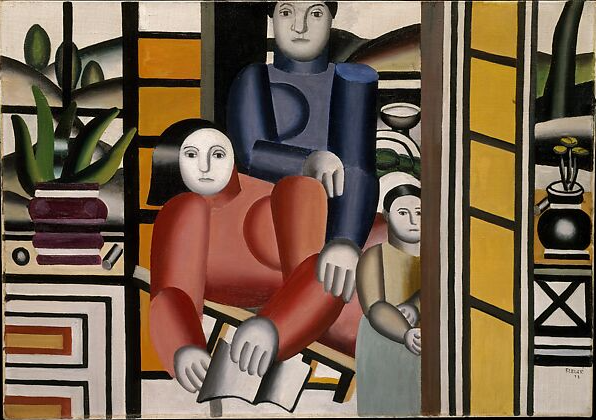
Fernand Léger was born in Argentan, France, on February 4, 1881. He was a French painter, film director, sculptor, scenographer, costume designer, designer, teacher, and graphic artist. He studied at the Académie Julian and the École nationale supérieure des arts décoratifs. Léger was influenced by Henri Rousseau. He worked in various locations, including Paris, Vienna, Caen, Gif-sur-Yvette, Berlin, Munich, Switzerland, and New York City. His work is associated with Cubism and Modernism. Léger died in Gif-sur-Yvette on August 17, 1955. His notable works include "Composition of three figures" (1932) and "The Alarm Clock" (1914).
Works
Notable works
- Study for "Mechanical Elements" (1918). Study for "Mechanical Elements", by Fernand Léger, from 1918, is a watercolor over graphite on paper in The Metropolitan Museum of Art. This work measures 13 by 9 3/8 inches. The collection records the date of 1918. The study depicts abstract subjects, with a focus on forms that suggest mechanical components. The combination of watercolor and graphite indicates a layered approach to developing the composition. Its dimensions are consistent with a preparatory work, offering insight into the artist's process of conceiving and refining abstract imagery related to industrial or mechanical themes.
- Woman with a Cat (1921). Woman with a Cat, by Fernand Léger, from 1921, is an oil on canvas in The Metropolitan Museum of Art. 5 cm). The collection records the date 1921 for this work. The subjects depicted are female nudes and cats. The scale of the canvas suggests a significant presence for the figures within the composition. The combination of a human figure and an animal allows for an exploration of form and interaction. The year of creation aligns with the recorded date of the work in the collection.
- Two Reclining Women (1913). Two Reclining Women by Fernand Léger, from 1913, is a gouache and charcoal on paper in The Metropolitan Museum of Art. This work measures 19 11/16 × 25 9/16 in. (50 × 65 cm). The collection records the work as being from 1913. The medium of gouache and charcoal on paper suggests a work that combines drawing and painting techniques, allowing for both precise lines and broad areas of color. Its dimensions indicate a moderately sized work, suitable for a detailed study or a finished piece on paper. The presence of two figures, as indicated by the title, allows for an exploration of form, interaction, or spatial relationships between subjects.
- The Smoker (1914). The Smoker by Fernand Léger, from 1914, is an oil on canvas painting in The Metropolitan Museum of Art. This work measures 39 1/2 x 32 in. 3 cm) and was recorded in 1914. The medium of oil on canvas suggests a finished work, distinct from a study. The dimensions indicate a substantial, though not monumental, painting, suitable for display. The title, “The Smoker,” points to a specific subject, though the visual details of the figure are not provided. The year of creation places it within a particular period of Léger's artistic development, just prior to significant global events.
- The Village (1914). The Village by Fernand Léger, from 1914, is an oil on canvas painting in The Metropolitan Museum of Art. The work measures 31 1/2 × 39 1/2 in. 3 cm) and was recorded in the collection in 1914. This painting depicts buildings and villages, subjects that often allowed artists to explore structural and geometric forms. The medium of oil on canvas suggests a finished work intended for exhibition. The dimensions indicate a medium-sized painting, suitable for a gallery wall. The year of creation places it within a period of significant artistic innovation, where traditional landscapes were being reinterpreted through new visual languages.
- The Children's Garden (1960). The Children's Garden, by Fernand Léger, from 1960, is a bronze sculpture in The Metropolitan Museum of Art. This work measures 22 inches by 25 inches by 18 3/4 inches. The collection records a date of circa 1952 for the conception of the work, with the cast made around 1960. The sculpture presents an abstract arrangement of forms. Its scale allows for a substantial physical presence, inviting viewers to consider the interplay of its various components and the artist's approach to three-dimensional abstraction across a span of years.
- Study of Objects (1930). Study of Objects, by Fernand Léger, from 1930, is a graphite on paper drawing in The Metropolitan Museum of Art. This artwork measures 12 5/8 by 9 3/8 inches. The collection records the date of 1930. The drawing explores abstract forms, presenting a composition of various elements. Its modest size suggests an intimate exploration of shape and line, characteristic of a study. Viewers can observe the artist's method of developing abstract ideas through drawing, focusing on the arrangement and interaction of distinct forms on a two-dimensional surface.
- The Bicyclists (1951). The Bicyclists by Fernand Léger, from 1951, is an oil on canvas painting in The Metropolitan Museum of Art. This work measures 51 1/2 × 38 1/2 in. 8 cm) and was recorded in the collection in 1951. The painting features boys, women, and bicycles, presenting a dynamic scene. The scale of the canvas allows for a significant visual impact, drawing the viewer into the activity depicted. The use of oil paint enables a richness of color and texture, contributing to the distinct forms of the figures and the machines. The composition captures a moment of movement and interaction among the subjects.
- Walking Flower (1957). Walking Flower, by Fernand Léger, from 1957, is a bronze and marble sculpture in The Metropolitan Museum of Art. The work measures 26 inches by 20 1/2 inches by 10 1/2 inches, with its base measuring 14 1/2 by 10 1/2 by 1 1/8 inches. The collection records the date as 1952, with the piece cast around 1957–59. The sculpture depicts flowers, rendered in a three-dimensional form that suggests movement. The combination of bronze and marble provides a material contrast, with the bronze likely forming the main floral elements and the marble serving as the base. The dates indicate a period of creation and casting that spans several years, suggesting a development from an initial concept to its final sculptural realization.
- Six Designs for Abstract Wall Decorations (1935). Six Designs for Abstract Wall Decorations by Fernand Léger, from 1935, is composed of graphite and gouache and is held in The Metropolitan Museum of Art collection. The work measures 16 5/8 x 27 5/8 in. 1 cm). The collection records its date as ca. 1940–1955. This piece presents abstraction as its primary subject. A viewer can discern Léger's exploration of non-representational forms and colors intended for architectural application. The multiple designs suggest a series of ideas or variations for a larger decorative scheme. The use of graphite and gouache indicates a focus on line and color in these conceptual studies.