26 July 1893 – 6 July 1959 · Berlin
George Grosz
Work
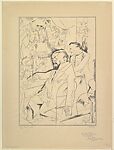
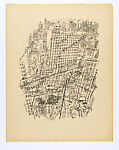
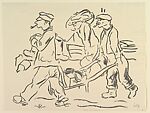
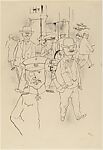
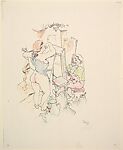
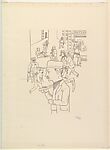
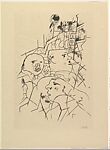
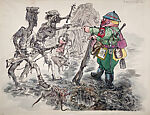
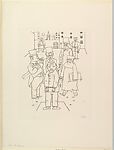
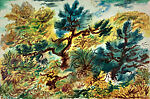
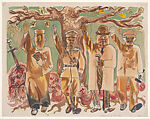
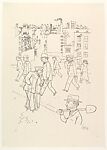
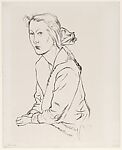
George Grosz created a variety of works, including paintings, drawings, and graphic art. His subjects ranged from cityscapes to still life and figurative scenes. Among his works are "Fishermen from Pomerenia (Fischer Aus Pommern)" from 1926 and "The Guilty One Remains Unknown" from 1919. He also painted "New York Harbor" and "Central Park at Night," both from 1936. Other notable pieces include "In the Street (Auf der Strasse)" from 1920, "The Pimps of Death," and "The Survivor," from 1936. Grosz also created "Still Life with Walnuts" in 1937, "Cafe Neptune" in 1919, and "The Prisoner (Der Gefangene)" in 1920. His work also includes "Memorial Day" (1933), "Berlin Street" (1931), and "The Ambassador of Good Will" (1943). He also created "I have done my part... the plunder is your affair!" (Act II, Scene 3), from Die Raüber in 1922.
Biography
George Grosz was born in Berlin on July 26, 1893. He was a German and United States citizen. He worked as a painter, draftsperson, photographer, university teacher, writer, illustrator, lithographer, and graphic artist. He was educated at the Dresden Academy of Fine Arts. Grosz worked in Berlin, Dresden, New York City, and Huntington. He resided in Berlin, Steglitz, Wilmersdorf, Charlottenburg, and West Berlin. His work includes "Fishermen from Pomerenia (Fischer Aus Pommern)" from 1926, "The Guilty One Remains Unknown" from 1919, "New York Harbor" from 1936, and "Central Park at Night" from 1936. He also created "In the Street (Auf der Strasse)" from 1920, "The Pimps of Death," "The Survivor" from 1936, and "Still Life with Walnuts" from 1937. Other works include "Cafe Neptune" from 1919, "The Prisoner (Der Gefangene)" from 1920, "Memorial Day" from 1933, "Berlin Street" from 1931, "The Ambassador of Good Will" from 1943, and "I have done my part... the plunder is your affair!" (Act II, Scene 3), from Die Raüber from 1922. He died in West Berlin on July 6, 1959.
Works