15 April 1812 – 22 December 1867 · Paris
Théodore Rousseau
Work
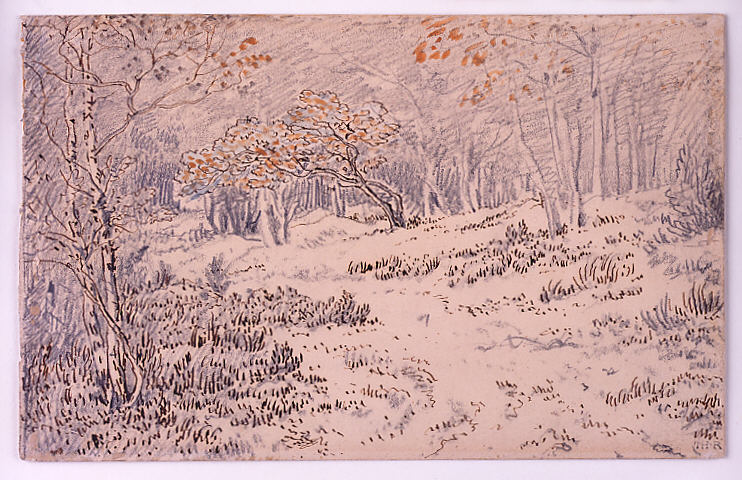
Théodore Rousseau created drawings and watercolors. His subjects included landscapes and natural scenes. For example, he made "Cliffs of Malbec at Mont-Dore, the Auvergne" in 1825, using graphite on laid paper. Another drawing, simply titled "Landscape," was created in 1842 with graphite heightened with white chalk on brown paper. "Trees in a Thicket," from 1845, is a drawing made with Conté crayon. He also produced "Wheatfields" in 1865, which is a watercolor over black chalk. All these works are part of The Metropolitan Museum of Art's collection.
Biography
Théodore Rousseau was born in Paris on April 15, 1812. He was a French visual artist who worked as a painter, photographer, draftsperson, printmaker, and graphic artist. He was associated with the Barbizon school movement. His work included landscapes such as "Cliffs of Malbec at Mont-Dore, the Auvergne" from 1825, "Trees in a Thicket" from 1845, and "Wheatfields" from 1865. He also created a drawing titled "Landscape" in 1842. Rousseau was influenced by artists such as John Constable, Richard Parkes Bonington, and Caspar David Friedrich. He died in Barbizon on December 22, 1867, of natural causes due to a myocardial infarction.
Works